

Maritimo C53 Sports Cabriolet – Sea Trial
A Thoroughbred Cruiser With Offshore Racing DNA
Written by Alan Jones
Reprinted From Sea Magazine / November 2012
 Knock knock.” “Who’s there?” “Micromanager … Now you say ‘Micro-manager who?’” For the most part, micromanaging is a bad thing, but when you apply it to yacht building like Maritimo does, then it’s all good. Following the “if-you-want-it-done-right-do-it-yourself” mantra, this Aussie boat builder takes the in-house philosophy to the extreme. It even has its own foundry, so its skilled workforce can produce components such as shafts, which are clocked to within a tolerance of 0.1 millimeter, skegs, rudders, couplings and, more recently, its own props. Not only is Maritimo assured of a quality product, but it is less vulnerable to vendor disruptions, which have been increasingly common during the downturn.
 Maritimo’s racing division might seem an unlikely contributor to its line of self-described long-range luxury motoryachts, but you can’t find a better way to test the durability of a component than by flogging it unmercifully during an offshore race. Aside from designing layups that can take the worst of it, components such as the racing steering systems, which are totally designed and built by Maritimo, are also used on vessels such as the C53 Sports Cabriolet we tested.
Our sea trial began at Hampton Yacht Group of California in Newport Beach, with a walk-through conducted by Bill King. We talked at length about the “Maritimo way,” which includes actual sea trials and shakedown cruises of between 50 and 400 miles to deliver the boats to different shipping ports, instead of just a quick dip in a tank at the factory. During the sea trial, a factory rep from the engine manufacturer is always present to make sure the power plants are running correctly. In Australia, the workforce still employs the apprentice system, so by the time employees are given an area of responsibility, they have had years of experience, which helps foster a craftsman mentality rather than a factory worker mentality.
“When we take delivery of a Maritimo,” King said, “there is very little tweaking needed before the customer takes delivery.”
As I walked toward the bow to help slip the lines, I discovered one of Maritimo’s signature features: the wide and deep walk-around with a tall wrap-around bowrail for greatly enhanced security. There’s even a place to clip a safety line for those times the seas are rockin’. At the bow, there are two rode lockers that help when using twin anchors to moor Bahamian style or for more security in a blow. A popular option is the sunpad on the foredeck ($5,826), but I’m not sure why it’s round instead of being the more human-conforming rectangular shape — other than being a distinctive styling feature. It’s the only feature I saw aboard the C53 where form eclipsed function.
SQUEEZE-PLAY DOCKING
As Hampton’s Chris Elliott prepared to pull us out of the slip, I got my first close look at the helm station and was a little surprised to see our yacht isn’t one of the ones equipped with the Volvo IPS joystick docking system — a feature new to the Maritimo line for 2012. I’ve become a big fan of the IPS system, which allows even rookie dockers to look like pros.
 Considering we are only about a foot away from a larger yacht to port when resting against the dock to starboard, it would seem as though we were at a severe disadvantage. We didn’t even have the optional ZF Joystick system that interfaces a bow thruster with the engines. But Elliott assured me it’s not a problem for our test boat, because it has fore and aft thrusters for added control. Both can be controlled by a key fob-like remote control.
“I actually prefer this setup,” Elliott said, “because with thrusters you can apply gentler corrections than with an IPS joystick. There are other advantages you’ll see when we get offshore.” Elliott skillfully maneuvered us out without touching anything, despite having only inches on either side.
Once free from the claustrophobic slip, I eased into the ergonomically correct Stidd helm chair, which is a standard feature on the boats delivered to the U.S. Curiously, the wood wheel is offset pretty far to the right of center of the chair, but it doesn’t take long to compensate. Twin 12.1 inch Raymarine E-Series Hybrid- Touch displays are placed perfectly, as are the twin combination power/shift levers. Tracking at idle was excellent as we made our way down the lengthy no-wake zone.
IN ITS ELEMENT
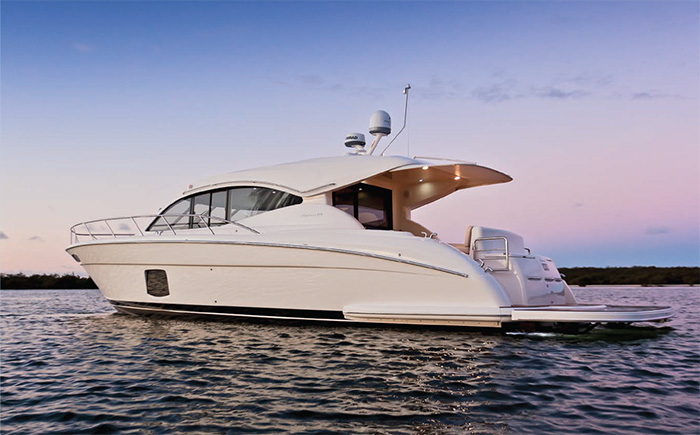
 Offshore, we were greeted by gentle 4-foot swells, and I opened up the throttles on the twin 715 hp Cummins QSM11 diesels, which are housed in the worker-friendly, well-insulated engine room. Even with no trim tabs employed, there was very little bow rise thanks to the C53’s weight distribution. The engines are farther forward than usual, allowing the C53 to sport a very shallow 7 degrees of prop shaft angle for greater engine efficiency when compared to the more typical 12 to 14 degrees, which vectors away thrust. Our 793-gallon fuel tank is placed just over the center of buoyancy, which also enhances balance. The upside of its efficient setup reveals itself with a time to plane of only 7.5 seconds.
After reaching a very happy cruising speed of 24 knots, which had our diesels purring at 2050 rpm, I added a little tab to fix the horizon at its proper position in my line of sight. I’m not sure why there are two trim-tab buttons, because I never once had to adjust to correct a list. When I backed off the throttle to see how slow the C53 could go while remaining on plane, Elliott instructed me to take the tab off, which is the opposite of the normal maneuver. At 14 knots (1500 rpm), we were still on plane and in full control. This superb balance is what Elliott was referring to when talking about the benefits of the inboard setup over the Volvo IPS-propelled C50, which places the engines farther aft. The C50 also has a narrower beam (15 feet, 9 inches vs. 17 feet, 1 inch for the C53), weighs considerably less and doesn’t have a keel because of the pod drives. According to Elliott, the C53 really illustrates what Maritimo is all about when running in rough conditions, which is no big surprise, since Australia is like the raised spindle in the center of a washing machine on Agitate. In adverse sea conditions, you can’t beat the torque of 1,430 hp compared to the 870 hp of the twin IPS engines.
Top speed is a healthy 31 knots at 2500 rpm, which puts our fuel burn at 74 gph. Dropping to 22 knots drops the fuel burn to 44 gph, and if you want to cruise at a 9-knot trawler speed while sipping 7 gph, you could theoretically run for 113 hours nonstop (if you could burn every gallon). But its best parlor trick was reserved for our run to port in a quartering, following sea. I pointed the C53 toward a fixed point on land and took my hands off the wheel … for several minutes without us changing course. Who needs autopilot?
APPOINTMENTS AND OPTIONAL ELECTIONS
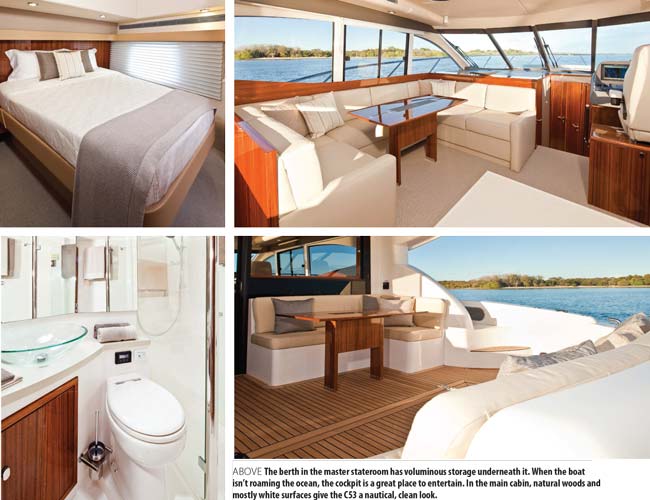
 Although previous-generation Maritimos have been more on the spartan side when it comes to interior appointments, company owner Bill Barry-Cotter has been persuaded to pursue a more luxurious path of late. The look up top is nautical and clean, with natural woods and mostly white surfaces. The salon and cockpit are on one level, which is a plus to prevent guests from stumbling, and while this is more of a cruiser than an entertainer, there’s plenty of room to stand on the teak deck or sit on the U-shaped lounge during well-attended parties. At the aft cockpit lounge is a built-in cooler, a freezer and a sink, with an option to add a grill ($1,465). The galley is topside (Who wants cooking smells down below?) and comes with an over/under refrigerator/freezer, a four-burner electric stove, a microwave and a drawer-style dishwasher. Workmanlike Corian tops the surface, and there is no granite upgrade available.
REAL ESTATE DOWN UNDER
Going down under to the cabin reveals a good use of space with an amidships master berth that has a large en suite head/shower compartment. Although it’s not a fullbeam cabin like the one on the IPS equipped C50, it’s roomier thanks to the flip-up bed, which has cavernous storage space underneath, in addition to a hanging closet. A large window to port, just in front of where the hull spray shoots out, gives you the impression you’re gliding over the water on a magic carpet.
The second, barely less than master berth is located in the bow, and although it doesn’t have the flip up bed storage because of the air conditioning unit, there are two drawers underneath and twin hanging lockers. It shares a head compartment with the crew/kid quarters on the starboard side, which features a single berth with an option to add a bunk bed. Inside this berth is the standard washer/dryer.
Pricing for the C53 Sports Cabriolet is $1,378,000 with the optional 715 hp Cummins diesels, a $44,165 upgrade over the standard 670 hp D11 Volvos (non-IPS). If you want a flybridge, tack on another $100,000. If your goal is to impress the folks at the yacht club during cocktail parties, there are other boats that can do that better. Keeping the C53 Sports Cabriolet tethered to a dock is akin to confining a thoroughbred horse in a stall. It wants to roam the open ocean in search of adventure, and you’re going to enjoy the journey as much as the destination.